Fishing After Heavy Rain: Do Fish Bite in Storms, Cold Fronts and Pressure Changes?
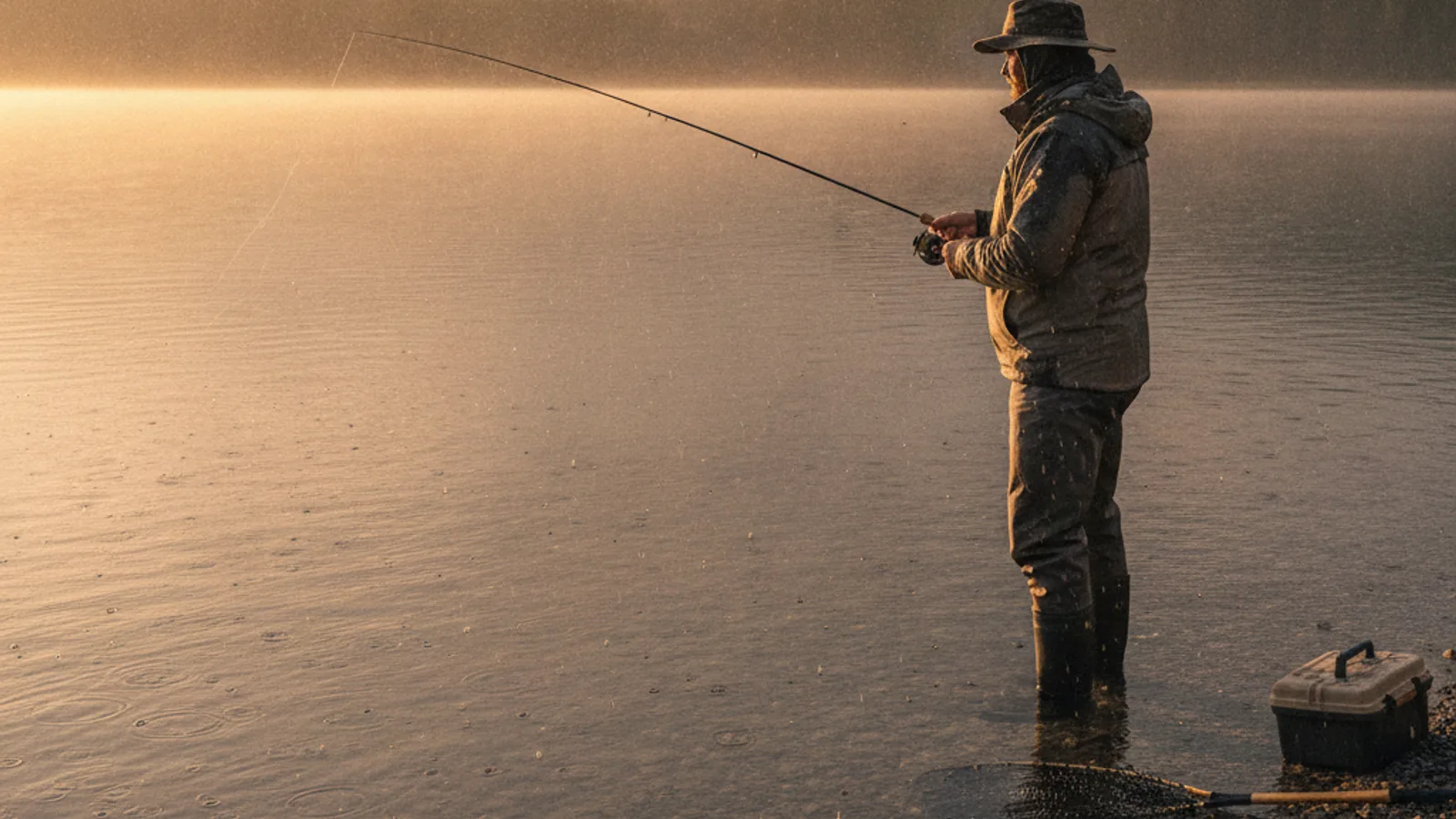
Every angler has watched clouds roll in and wondered the same thing: should I pack up, or is this about to get good? The short answer is that weather changes drive some of the best (and worst) fishing of the week. Falling pressure ahead of a front can flip the bite on like a switch. A bluebird sky the day after can shut it down just as hard. This guide walks through exactly how rain, storms, cold fronts, warm fronts, and barometric pressure affect fish, and how to time your trips around all of it.
One note before we start: you don't have to memorize any of this to benefit from it. The free Fishn Buddy forecast already factors barometric pressure, wind, and weather into the fishing score for your spot. Everything below explains why the score moves the way it does, so you can trust it and fine-tune your approach on the water.
Why Barometric Pressure Matters to Fish
Barometric pressure is simply the weight of the atmosphere pressing down on the water. Fish sense pressure changes through their swim bladder and lateral line, and many anglers believe those changes affect how comfortable fish feel moving around and how the tiny organisms at the bottom of the food chain behave.
What matters most is not the exact number but the direction of change:
- Falling pressure (a front approaching): fish feed aggressively. This is the classic pre-front feed window.
- Steady, moderate pressure (roughly 29.9 to 30.1 inHg): normal, predictable fishing. Fish follow their usual daily patterns.
- Rising or high steady pressure (after a front passes, often above about 30.2 inHg): the tough stretch. Fish hold tight to cover and feed in short, reluctant windows.
A useful rule of thumb: when the barometer starts falling below roughly 29.9 inHg ahead of weather, that is your cue to go fishing, not to cancel. When it spikes high and holds there under clear skies, lower your expectations and change your tactics (more on that below).
Do Fish Bite Good Before a Cold Front?
Yes, and it is often not close. The 12 to 24 hours before a cold front arrives is frequently the single best fishing window of the entire week.
As the front approaches, barometric pressure drops steadily, clouds build, and wind picks up. Fish respond by feeding hard, almost as if they know conditions are about to turn. Bass roam off cover and chase moving baits. Walleye push shallow earlier than usual. Panfish schools feed through the middle of the day instead of just at dawn and dusk.
How to fish the pre-front window:
- Speed up. Fish are willing to chase. Spinnerbaits, chatterbaits, lipless cranks, and fast-moving swimbaits shine.
- Cover water. Strike zones are large, so this is the time to hit a lot of spots quickly rather than soaking one hole.
- Fish the wind. The wind-blown bank concentrates bait and stirs up food. Casting into the chop feels wrong and works great.
- Stay late (safely). The bite often builds right up until the front actually hits. Just watch the sky and get off the water before any lightning arrives.
If you can only fish one day this week, check the pressure trend on your spot's Fishn Buddy forecast. A falling barometer plus a decent solunar window is as close to a sure thing as fishing offers.
Do Fish Bite After a Cold Front? The Bluebird-Day Problem
Here is the flip side. The day or two after a cold front passes is widely considered the toughest fishing of the weather cycle. You will recognize it immediately: crystal-clear "bluebird" skies, bright sun, cooler air, light wind, and a barometer sitting high and steady.
Fish do not stop eating after a front, but their behavior changes completely:
- They pull tight to cover: buried in weed clumps, under docks, pinned to laydowns, or hugging the bottom on deep structure.
- Strike zones shrink from feet to inches. A bait swimming past three feet away gets ignored.
- Feeding windows get short. Instead of feeding for hours, fish may snap up food for twenty minutes and shut back down.
The fix is a total tactical reversal from the pre-front approach: downsize and slow down.
- Drop to smaller baits: a finesse worm instead of a full-size jig, a 2-inch grub instead of a 4-inch swimbait, smaller live bait.
- Slow everything. Drag, deadstick, and shake baits in place. Long pauses trigger post-front fish that will not chase.
- Make repeated casts to the same piece of cover. Post-front fish often need the bait put on their nose several times.
- Fish the thickest, shadiest cover you can find, or the deepest structure adjacent to where fish were feeding before the front.
Conditions usually normalize after two or three days of stable weather, and the whole cycle starts again with the next front.
Do Fish Bite in the Rain?
This is one of the most common weather questions in fishing, and the answer depends almost entirely on how hard it is raining.
Light to Moderate Steady Rain: Yes, Go Fishing
A soft, steady rain is genuinely good for fishing, for three concrete reasons:
- Rain washes food into the water. Worms, insects, and terrestrial food get flushed off banks and down feeder creeks. Fish learn to stage near inflows when it rains.
- Rain breaks up surface visibility. The dimpled surface makes it harder for fish to see you, your line, and overhead threats. Fish that would hide under a bright sky feed confidently in the shallows.
- Rain oxygenates the water. Raindrops churn oxygen into the surface layer, which matters a lot in warm summer water where oxygen runs low. More oxygen means more active fish.
During a light rain, fish the places food enters the water: creek mouths, culverts, drainage points, and wind-blown banks. Darker or noisier baits help fish find your offering under the broken surface.
Heavy Rain: The Bite Usually Slows
A hard downpour is a different story. Heavy runoff dumps mud and silt into the water fast, and rapidly muddying water slows the bite. Fish struggle to see, sudden temperature swings from cold runoff put them off, and strong inflows can push them out of their normal spots.
If you get caught in a blowout rain, look for the cleanest water you can find, often the mudline edge where dirty and clear water meet, or a protected arm of the lake that drains less land. And give freshly muddied water a day or two to settle before expecting normal fishing again.
Do Fish Bite During Storms and Before a Storm?
The hours before a storm behave just like the pre-front window described above: pressure falls, clouds kill the sun penetration, and fish feed hard. Many anglers' best days happen under a darkening sky with thunder still miles off.
But this comes with the one absolute rule in this entire article: if there is lightning, get off the water. No exceptions. Not "one more cast," not "it's still far away." Open water makes you the tallest object around, graphite rods conduct electricity, and lightning routinely strikes well ahead of the rain itself. If you can hear thunder, you are within striking range. Get to shore, get away from the water, and wait at least 30 minutes after the last thunder before going back out. The pre-storm feed window closes hours before the actual danger arrives, so you lose almost nothing by leaving early.
After a Thunderstorm
Fishing right after a thunderstorm is a mixed bag. If the storm was a quick summer pop-up that passed without much rain, the bite can resume quickly, and the cloud cover left behind often keeps fish shallow and feeding. If the storm was the leading edge of a true cold front, expect the post-front slowdown to follow, and adjust with the downsized, slowed-down approach above. If it dumped heavy rain, factor in muddy runoff too.
Warm Fronts: The Quiet Improver
Cold fronts get all the attention, but warm fronts matter too, and the news is good. As a warm front moves in, pressure falls gently, cloud cover increases, and temperatures rise gradually. Fishing tends to improve steadily over the course of a warm front rather than spiking and crashing.
This is especially true in spring and fall, when a few degrees of warming water can pull fish shallow and extend feeding windows all day. Several consecutive warm, stable, slightly overcast days are some of the most consistent fishing you will find. They lack the fireworks of a pre-cold-front feed, but they also lack the hangover.
Wind: The Underappreciated Factor
Many anglers avoid windy days, but experienced fishermen seek them out. Wind is one of the most overlooked advantages in freshwater fishing.
- Wind creates current. Even on lakes with no natural current, wind pushes water and creates flow that concentrates baitfish and activates predators.
- Wind breaks up light penetration. Choppy water reduces visibility, making fish less cautious and more likely to commit to a strike.
- Wind pushes bait. Plankton and baitfish get blown to windward shores, and predators follow. The windblown bank is almost always more productive than the calm side.
5 to 15 mph is the sweet spot: enough chop to break the surface without making boat control difficult. Position yourself to cast into the wind-driven shoreline. At 15 to 25 mph, fish the lee side of points and islands where calm and churned water meet. Dead calm is often the hardest condition on clear-water lakes: fish become spooky, feeding windows shrink, and long casts with light line are necessary.
One useful rule: if wind has been blowing from the same direction for more than a day, the windblown bank has been stacking baitfish. Start there. A wind direction change takes 6 to 12 hours to shift the food chain, so do not expect an instant bite flip.
Temperature Trends and Fish Metabolism
Fish are cold-blooded. Their metabolism, activity level, and appetite are all directly tied to water temperature, but it is the rate of change that matters most, not the absolute number.
Warming trends (two or three consecutive days of gradually rising temperature) increase fish metabolism and feeding activity. Spring warming trends trigger pre-spawn feeding binges. In summer, sustained warming pushes fish deeper as surface water exceeds their comfort zone.
Rapid cooling (a cold front dropping air temps 15 degrees overnight) shuts down feeding for 24 to 48 hours. The fish do not disappear; they just stop cooperating until they adjust.
Stable temperatures in a species' preferred range produce the most reliable, predictable fishing: bass feed best between roughly 55 and 80 degrees F, trout prefer 45 to 65 degrees F, and walleye are most active between 55 and 70 degrees F. When water temperature is steady in these ranges, fish follow consistent daily patterns that local knowledge can predict.
Cloud Cover and Surface Activity
Overcast skies are underrated by beginners and prized by experienced anglers. Under cloud cover, fish feel safer leaving structure to roam and feed. Feeding windows that are limited to dawn and dusk on a bluebird day can stretch through the entire midday under consistent clouds.
Topwater fishing is dramatically better under overcast skies. Bass, pike, and musky are significantly more likely to blow up on a surface lure when light is diffused than when the sun is blazing.
On sunny days, the adjustment is straightforward: focus on shade. Docks, overhanging trees, bridge pilings, and the shaded edges of weed clumps hold fish that would otherwise be feeding in the open. Deep structure is the other option when no shade exists at the surface.
Which Fish Are Most Sensitive to Pressure Changes?
Pressure affects all species with a swim bladder, but the response varies:
- Bass: Highly responsive. Pre-frontal feeding binges are well-documented and the effect is real.
- Crappie: Very sensitive. A falling barometer can switch a crappie bite on like a light.
- Walleye: Responsive, especially during low-light pre-frontal windows when they push shallower than usual.
- Trout: Moderately affected. They feed more actively under overcast, low-pressure conditions.
- Catfish: Less governed by pressure, more driven by water temperature, current, and scent.
- Saltwater species: Pressure matters, but tidal flow and solunar periods typically dominate the bite window.
A rate-of-change note that applies across all species: a pressure shift of 0.02 inHg per hour or more is enough for fish to notice. A rapid drop of 0.05 inHg per hour or greater, the kind that precedes a major storm, produces the most dramatic feeding response. A slow drift over 12 hours still influences behavior, just with less urgency.
Putting It Together: A Weather Cheat Sheet
| Condition | Bite | Strategy |
|---|---|---|
| Falling pressure, front approaching | Best of the week | Fish fast, cover water, fish the windblown bank |
| Light, steady rain | Good | Fish inflows and shallows, use darker or noisier baits |
| Heavy rain and fresh mud | Tough | Find clean water or fish the mudline edge |
| Lightning | Stop fishing | Off the water immediately; wait 30 min after last thunder |
| Post-front bluebird day | Toughest | Downsize, slow down, fish tight to cover or deep structure |
| Days 2-3 after front, stable pressure | Improving | Fish settle back into patterns; normal tactics resume |
| Warm front, gradual warming | Good, improving | Normal tactics; especially strong in spring and fall |
| 5-15 mph wind | Good | Fish the windblown bank; chop breaks up visibility |
| Dead calm, bright sun | Challenging | Fish shade, docks, deep structure; long casts and light line |
| Overcast, stable clouds | Good all day | Extend feeding windows; topwater and reaction baits work all day |
Weather is only one layer of the timing puzzle. Stack it with the daily bite windows in our moon phase and solunar guide, and if you fish salt or brackish water, add the water-movement windows from our tide fishing guide. When a falling barometer, a major solunar period, and moving water all line up, clear your schedule.
Pro Tip: You don't need to watch a barometer all week. The Fishn Buddy fishing score already bakes pressure trend, wind, and weather into a single number for your exact spot. When the score jumps ahead of incoming weather, that is your pre-front window. Planning a trip to new water? Browse conditions by lake on our lake maps index.
Check the Bite Window at Your Spot
Fishn Buddy shows real-time fishing scores that factor barometric pressure, wind, and weather for 3,900+ locations, free.
Check Today's Forecast →The Friday Bite Report
Want the pressure and moon read done for you each week? One short email every Friday: this week's moon phase and bite windows, plus one piece of gear worth knowing about. No spam, unsubscribe anytime.
Rather not check the pressure yourself every week? Hit "Save this lake" on any lake page to build your own list, then get a Friday email with the weekend outlook for exactly those waters. Free, no account.
Frequently Asked Questions
Do fish bite in the rain?
Yes, fish often bite well in light to moderate steady rain. Rain washes insects, worms, and other food into the water, breaks up surface visibility so fish feel safer feeding shallow, and adds dissolved oxygen. Heavy downpours are the exception: runoff muddies the water quickly and the bite usually slows until it clears.
Do fish bite good before a cold front?
Yes. The 12 to 24 hours before a cold front arrives is often the best fishing window of the entire week. Barometric pressure falls as the front approaches, and fish respond by feeding aggressively, as if stocking up before conditions change. Roaming fish chase faster presentations and strike zones get bigger.
Do fish bite after a cold front?
Fish still bite after a cold front, but it is the toughest period. High pressure and clear bluebird skies push fish tight to cover and deep structure, and they become lethargic. Downsize your baits, slow your retrieve, and fish tight to thick cover or the bottom. Conditions usually improve after two or three days of stable weather.
Do fish bite during storms?
The bite often peaks in the hours leading up to a storm as pressure drops, and can stay strong in the early stages of steady rain. But if there is any lightning, get off the water immediately. No bite is worth being the tallest object on open water holding a graphite rod during a thunderstorm.
What barometric pressure is best for fishing?
Falling pressure, especially as it drops below roughly 29.9 inHg ahead of a front, is the classic feed window. Steady pressure around 29.9 to 30.1 inHg produces normal, reliable fishing. High steady pressure above about 30.2 inHg right after a front is typically the toughest, with fish holding tight to cover and feeding in short windows.
Is it good to fish while raining?
A light, steady rain is one of the better times to fish. Fish feed more confidently under a broken surface, food gets washed into the water, and inflowing runoff points concentrate baitfish. Bring rain gear, focus on inflows and shallow feeding zones, and avoid the water entirely if there is lightning.
Should I fish in the wind or find calm water?
Generally, fish in the wind. Wind-blown shorelines concentrate baitfish and activate predators. Dead calm is often the hardest condition on clear-water lakes. The exception is sustained wind over 20 mph making boat control impossible; in that case find a protected arm of the lake while still staying near wind-driven water movement.
Do fish bite when the barometer is rising?
Yes, but it is slower. The first 12 to 24 hours of rising pressure right after a cold front are the toughest. After that, fish acclimate and resume normal feeding. Use smaller, slower presentations during this window and expect conditions to improve steadily on day two and three.
How quickly does barometric pressure need to change to affect fishing?
A change of roughly 0.02 inHg per hour or more is enough for fish to notice. A rapid drop of 0.05 inHg per hour or greater, the kind that precedes a major storm, produces the most dramatic feeding response. Slow, gradual changes over many hours still influence behavior, just with less urgency.
FISH SMARTER ⚓
FIND YOUR SPOT →