Home › Blog › Best Ice Fishing Lures 2026
Best Ice Fishing Lures 2026: Blade Baits, Jigging Spoons and Jigs for Walleye, Perch and Crappie
Ice fishing lures are a smaller category than open-water tackle, but the differences between a productive lure and a ignored one are sharper under the ice than in any other fishing situation. Cold water slows fish metabolism, reduces lateral line sensitivity in some species, and concentrates fish into tight predictable bands where they can inspect a lure for seconds before committing or turning away. The lure type, size, action, and color all matter more per fish than they do in summer.
The eight picks below cover the four main ice fishing lure categories: blade baits and jigging spoons for walleye, lake trout, and pike; vertical jig heads with soft plastics or live bait for perch and walleye; tungsten teardrop jigs for crappie and bluegill; and swimming baits for aggressive reaction strikes from large predators. Each pick is matched to specific species, depth ranges, and conditions rather than treated as a one-size-fits-all recommendation.
Quick Picks: Ice Fishing Lure by Species and Depth
| Target Species | Best Lure Type | Depth Range | Best Colors |
|---|---|---|---|
| Walleye | Blade bait or Jigging Rap | 15 to 35 ft | Chrome, gold, fire tiger |
| Yellow perch | Jig head + minnow | 10 to 30 ft | Silver, gold, chartreuse |
| Crappie | 1/32 oz jig + soft plastic | 8 to 20 ft | Glow white, chartreuse, pink |
| Bluegill | Tungsten teardrop jig | 6 to 15 ft | Glow chartreuse, red, orange |
| Lake trout | Heavy jigging spoon (Swedish Pimple) | 40 to 80 ft | Chrome, blue/silver, glow |
| Northern pike | Jigging Rap or dead-bait rig | 6 to 20 ft | Firetiger, perch, natural shiner |
| Lake trout / whitefish | Rattle jigging spoon | 30 to 60 ft | Glow gold, chartreuse glow |
| Mixed panfish | Ice fishing lure assortment kit | 6 to 15 ft | Multiple, matched to clarity |
At a Glance
 Heddon Sonar Blade Bait Chrome
 Northland Fire-Ball Jig
 Bobby Garland Crappie Baits
 Rapala Shad Rap 05
Product images and titles from Amazon. As an Amazon Associate we earn from qualifying purchases.
The 8 Best Ice Fishing Lures
Heddon Sonar Blade Bait Chrome 1 7/8"
The Heddon Sonar blade bait has been the benchmark walleye ice lure for decades, and the 1 7/8 inch chrome version remains the standard for mid-depth fishing from 15 to 35 feet. The lure produces vibration on both the lift and the fall, which means it triggers fish during the entire presentation rather than only on the pause. The correct retrieve is a sharp 4 to 6 inch snap lift, then a controlled fall on near-slack line so the Sonar can flutter and vibrate freely as it drops. Walleye almost always strike on the fall, so keeping the line loose enough that the lure sinks under its own weight is critical. In rocky or sandy basin areas with hard bottom, where walleye hug bottom structure, a 3 to 4 inch snap followed by a 2 second controlled fall keeps the lure in the strike zone without burning past suspended fish.
The chrome finish reflects light at all angles in clear water and produces reliable walleye and large perch in lakes with good visibility. In stained water or low-light conditions early and late in the day, switch to a gold or fire tiger Sonar, which generates more contrast at close range. The blade bait also works for lake trout in shallower water (15 to 25 feet) where lakers cruise hard-bottom structure near shoals. Pair with 6 lb fluorocarbon line for minimal stretch and low visibility in clear ice-fishing conditions.
Pros
- Vibrates on both the lift and fall for a longer strike window
- Chrome finish triggers reflection strikes in clear water
- Effective for walleye, large perch, and lake trout on hard bottom
- Proven multi-decade track record in northern lakes
Cons
- Less effective in murky water where vibration outperforms flash
- Treble hooks require careful handling in cold gloves
Rapala Jigging Rap 5
The Rapala Jigging Rap in size 5 (2 inches, 5/16 oz) is the most widely used ice fishing lure in North America for walleye and is considered the starting point for any ice fishing lure collection. After a sharp 6 to 10 inch lift, the Jigging Rap darts away and swims in a wide 12 to 18 inch circle before settling back to a horizontal position with its nose slightly down. That glide mimics a dying shad or emerald shiner and triggers a reaction bite from walleye that may have ignored a vertical lure. The horizontal fall is the key difference from a blade bait or jigging spoon: it stays in the strike zone at the fish's level during the swim rather than dropping past it.
Fish it in water from 8 to 35 feet. In shallow water under 12 feet, use size 3 (1.5 inches, 3/16 oz) for a smaller profile. The standard working depth for size 5 is 15 to 30 feet where walleye hold over main basin structure. For pike through the ice, size 7 (2.75 inches, 9/16 oz) in firetiger or perch color draws the most strikes and is large enough to hook pike securely. Connect with a small snap swivel to prevent line twist during the swimming retrieve. In the northern tier of states, this lure is legal for tip-up use in states that allow artificial lures on tip-ups.
Pros
- Wide swimming glide on the fall triggers walleye that ignore vertical lures
- Multiple sizes cover panfish through pike
- Works across the full winter season from first ice through late ice
- The most recognized and trusted ice fishing lure brand
Cons
- More expensive per lure than blade baits or jigging spoons
- Requires more line control skill to produce the correct swimming action
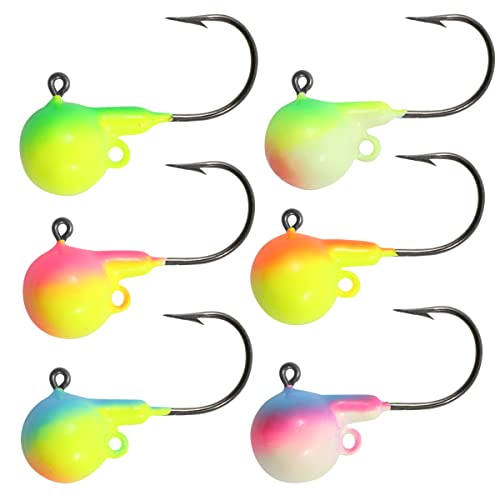
Northland Fire-Ball Jig 1/8 oz
The Northland Fire-Ball Jig in 1/8 oz is the standard starting setup for ice fishing perch and walleye with live or cut bait. Its short-shank, wide-gap hook positions the bait point-up with the hook exposed just outside the bait body, which reduces short-strikes when perch nip the bait without fully committing. Tip the hook with a full live minnow (1.5 to 2 inches) through the lips for walleye, or with a single minnow head for perch that are feeding aggressively. In colder water below 35 degrees, a single minnow eye on the hook draws more bites than a full minnow, because perch inspect baits closely in very cold water and a smaller bait trigger is less likely to be refused.
The 1/8 oz weight is appropriate for 12 to 25 feet of water. In deeper water over 30 feet, step up to 1/4 oz to reach the bottom faster and maintain more direct contact with the bait during the presentation. The round-ball head generates a gentle horizontal wobble on the fall that perch and walleye both respond to without spooking. Pair the jig with 4 lb monofilament or fluorocarbon ice fishing line on a medium-light ice rod. See the ice fishing rod guide for rod and reel pairings by target species.
Pros
- Wide-gap hook reduces short strikes from perch and crappie
- Works with live minnows, cut bait, or soft plastics on the same head
- Available in 1/64 through 1/4 oz for all ice fishing depths
- Trusted brand with consistent hook quality
Cons
- Requires live or cut bait for maximum effectiveness versus artificial-only setups
- Less productive than blade baits and jigging spoons for aggressive reaction fishing
Bobby Garland Baby Shad 2" on 1/32 oz Jig Head
Bobby Garland Crappie Baits in the 2 inch Baby Shad profile are the industry standard soft plastic for ice fishing crappie and large bluegill. The paddle tail generates a tight wobble even at the very slow fall speed required to trigger cold-water panfish, and the bait works on a 1/32 oz jig head fished vertically under a small slip float at 6 to 15 feet. Crappie through the ice typically suspend over deep water basins from 8 to 20 feet below the surface, and fishing the Bobby Garland under a float set at the correct suspended depth keeps the bait in the crappie's viewing zone during the entire presentation rather than drifting below it.
For color, Pearl White and Monkey Milk are the most consistent year-round crappie producers in clear to lightly stained water. In stained or greenish water, switch to Chartreuse or Orange and Chartreuse. Glow-tipped jig heads with a Bobby Garland body extend the productive window through the low-light periods 30 minutes before and after sunrise and sunset when crappie are most active under the ice. Replace the body after every three to five fish; the bait compresses with use and loses its tail action. See the crappie rig guide for open-water crappie presentations.
Pros
- Paddle tail works at very slow cold-water fall speeds
- Wide color selection covers clear, stained, and low-light conditions
- Available in 1.5 and 2 inch sizes to match crappie and bluegill mouth sizes
- Consistently produces from first ice through late ice
Cons
- Body compresses quickly; restock before each trip
- 2 inch body is slightly large for small bluegill under 7 inches
Northland Buck-Shot Rattle Spoon
The Northland Buck-Shot Rattle Spoon adds a sound chamber to the standard jigging spoon formula, which matters in two specific situations: murky ice water where fish cannot see the flash, and deep-water fishing over 30 feet where vibration travels further than light. The rattle produces a BB-style clicking sound on the lift that attracts walleye and lake trout from a wider radius than a silent spoon in the same conditions. On the fall, the flutter of the spoon body and the sound of the rattle combine to trigger strikes from both active fish and those that followed the sound but were not yet committed to a bite.
Work it with a medium-weight ice rod rated for 8 to 12 lb line in a 4 to 6 inch snap lift followed by a controlled fall. In clear water, use the gold or natural shiner colors that match the predominant forage. In murky water or low light, chartreuse glow or orange glow patterns produce well because they combine visual contrast with the sound attractant. The Buck-Shot spoon is also effective for lake whitefish in northern Canadian shield lakes where jigging spoons with rattle are a common local technique for suspended whitefish at 20 to 45 feet.
Pros
- Rattle chamber attracts fish from further away in murky or deep water
- Combined sound and flutter action works for walleye, lake trout, and whitefish
- More effective than silent spoons in low-visibility late-season ice conditions
Cons
- Rattle can spook very finicky fish in ultra-clear shallow water
- Less flutter on the fall than a heavier flutter-style spoon like the Swedish Pimple
Swedish Pimple 1/4 oz to 3/8 oz
The Swedish Pimple, manufactured by Bay de Noc Lure Company, is the standard jigging spoon for lake trout and deep walleye in large natural lakes and Canadian shield shield waters. The heavy brass or chrome body drops fast and true through deep water, reaching 40 to 80 feet without excessive bow in the line that would mask the strike signal. On the lift, the spoon flutters and darts erratically; on the fall, it glides and spins in a tight corkscrew that mirrors a distressed shad or cisco descending through the water column. Lake trout respond to this presentation consistently from December through ice-out in northern lakes.
The 1/4 oz size is the starting point for lake trout in 20 to 45 feet; the 3/8 oz and 1/2 oz sizes are used in water 45 to 80 feet deep where the heavier body maintains better line contact. For deep walleye that have moved off mid-basin structure into the deepest sections of the lake by late February, a 3/8 oz chrome Swedish Pimple worked with a 4 to 6 inch lift-and-drop retrieve is one of the most consistent techniques. Dress the hook with a small minnow head or a single smelt eye to add a scent trigger. Pair with 8 to 10 lb braided line for deep-water sensitivity.
Pros
- Fast sink rate reaches deep lake trout and walleye quickly
- Flutter on the fall produces strikes from lake trout in 40 to 80 feet
- Decades of proven performance on Canadian shield and Great Lakes lake trout
- Inexpensive and extremely durable
Cons
- Too heavy and fast-sinking for shallow panfish in 6 to 15 feet
- Requires thicker line (8 to 10 lb) for deep-water use, which reduces sensitivity
VMC Tungsten Jig Size 2 to 4
A VMC tungsten jig in size 2 to 4 (roughly 1/100 to 1/64 oz) is the most effective ice fishing lure for bluegill, yellow perch, and crappie in clear water under high-pressure conditions. Tungsten is approximately twice as dense as lead, so a size 4 tungsten jig sinks nearly as fast as a larger lead jig of double the weight while presenting a much smaller profile. In very clear ice water where panfish approach the bait from below and inspect it closely, a smaller presentation draws significantly more strikes than an equivalent lead jig of the same weight. The VMC line offers glow and UV finishes that remain visible in the low-light window under ice before dawn and after sunset when panfish feed most actively.
Tip the hook with a single wax worm, spike (maggot), or small piece of soft plastic. The standard presentation is a 2 to 4 inch slow lift followed by a controlled fall and a 3 to 5 second pause at the bottom. Most bites occur on the pause. Many ice anglers use a spring bobber on the rod tip to detect the light tap of a bluegill bite through the ice, since tungsten jigs are light enough that a standard sensitive tip may not register a short strike. Run 2 lb monofilament or 2 lb fluorocarbon for maximum sensitivity with light tungsten jigs.
Pros
- Dense tungsten sinks fast and presents a small profile at the same weight as lead
- Most effective finesse option for pressured bluegill and perch in clear water
- Glow and UV options extend the productive window at dawn and dusk
- Works for bluegill, perch, crappie, and small trout through the ice
Cons
- Significantly more expensive per jig than lead teardrops
- Very small size (4 and smaller) is difficult to handle in cold gloves on the ice
Rapala Shad Rap 05
The Rapala Shad Rap 05 is primarily known as an open-water lure, but it performs in two specific ice fishing situations: as a dead-stick bait rigged under a tip-up for northern pike, and as a slow-jigged crankbait worked with a 1 to 2 inch lift-and-pause retrieve for large walleye in 8 to 20 feet. For dead-stick pike fishing, a 5/0 quick-strike rig attached through the Shad Rap's body suspends it at 2 to 4 feet below the ice hole where pike cruise shallow weed edges. The Shad Rap's natural shiner profile, pressed into a horizontal dead-stick position, is one of the most consistent dead-bait setups for trophy pike in states that allow artificial lures on tip-up rigs. Check your local regulations before use; tip-up rules vary by state.
For tip-up rigs with live or dead bait, a tip-up flag indicates a pike strike without requiring the angler to hold a rod. Set tip-up depth at 12 to 18 inches above the bottom for walleye and at 2 to 4 feet below the ice surface for shallow pike. Keep a safety spud bar and ice picks accessible when covering multiple tip-up holes across a large area of ice.
Pros
- Natural shiner profile works as dead-stick bait for trophy pike
- Can be slow-jigged as a crankbait for large walleye in shallow to mid-depth ice water
- Durable build handles repeated use across ice fishing seasons
Cons
- Tip-up use requires checking state regulations (artificial lures allowed varies by state)
- Less versatile than the Jigging Rap for general walleye ice fishing
Ice Fishing Lure Color Selection by Water Clarity
| Water Clarity | Top Colors (Walleye) | Top Colors (Panfish) | Avoid |
|---|---|---|---|
| Clear (4+ feet visibility) | Chrome, natural shiner, gold | Glow white, pink, pearl | Solid dark colors |
| Lightly stained (2 to 4 feet) | Gold, fire tiger, chartreuse | Chartreuse, orange, glow | Chrome (less reflective) |
| Stained (under 2 feet) | Chartreuse glow, orange, gold glow | Hot orange, chartreuse glow | Natural muted colors |
| Low light (dawn/dusk) | Glow gold, glow chartreuse | Glow white, glow red, UV | Standard chrome (no glow) |
Ice Fishing Lure Setup: Rod, Reel and Line
Ice fishing rods are shorter than open-water rods, typically 24 to 38 inches, and rated for lighter line than their open-water equivalents. For the blade baits and jigging spoons in this guide, a medium to medium-heavy 30 to 32 inch ice rod rated for 6 to 10 lb line provides enough backbone to transmit the snap-lift action that blade baits require while remaining sensitive enough to detect a walleye bite on a controlled fall. For panfish jigs and tungsten teardrops, a lighter ultralight 24 to 28 inch rod rated for 2 to 4 lb line is more appropriate and allows detection of light perch or bluegill bites. See the full ice fishing rod guide for species-matched recommendations across the walleye, panfish, and pike categories.
For line, 6 lb fluorocarbon is the standard choice for blade baits and jigging spoons targeting walleye: its low stretch transmits the snap lift precisely, and its near-invisibility in clear ice water reduces detection. For panfish, drop to 2 to 3 lb fluorocarbon or monofilament; lighter line is essential for detecting the subtle bites that bluegill and crappie deliver through a small tungsten jig. For deep-water lake trout with heavy spoons, 8 to 10 lb braided line with a 6 to 10 inch fluorocarbon leader provides the sensitivity to detect strikes at 60 feet while the braid's thin diameter cuts through line bow in deep water.
Ice Fishing Safety
Before accessing any frozen body of water, check ice thickness with a chisel or power auger at multiple points. As a baseline from agencies such as the Minnesota DNR: 4 inches of new, clear blue ice is the minimum for a single angler on foot. White or opaque ice that formed from snow or slush is weaker and requires roughly double the thickness for the same load. Conditions vary by location and weather history, so always check with the local state fisheries office or county sheriff before accessing a new body of water. See the ice fishing safety gear guide for ice picks, spud bars, rope, and float suit recommendations.
Frequently Asked Questions
What is the best all-around ice fishing lure for walleye?
The Rapala Jigging Rap in size 5 is widely considered the best all-around walleye ice lure because its swimming glide on the fall triggers both reaction bites and follow-up strikes. After a sharp 6 to 10 inch lift, it swims in a wide circle and settles back to a horizontal position. The Heddon Sonar blade bait is the second most consistent choice, especially in deeper water over 25 feet where its tight vibration travels further and draws fish from a wider radius.
What ice fishing lures work best for perch?
Yellow perch respond best to small vertical jigs tipped with live bait. A 1/8 oz Northland Fire-Ball Jig with a live minnow is the most consistent perch setup from first ice through late season. Small jigging spoons in silver or gold worked with a 2 to 3 inch lift-and-quiver also produce for perch in deeper water. Tungsten jigs in sizes 4 to 6 tipped with a wax worm outperform lead jigs for finicky mid-winter perch in pressured clear-water lakes.
How deep should I fish ice fishing lures for walleye?
Walleye through the ice typically hold 2 to 5 feet off the bottom during daytime and rise within 10 feet of the surface during low-light feeding windows at dawn and dusk. Start with your lure 3 feet off bottom and work up in 5-foot increments until you mark fish on a sonar or get a bite. In most natural lakes, walleye concentrate at 18 to 35 feet under first ice and move progressively deeper as winter advances. In rivers and reservoirs, walleye often hold in 6 to 15 feet near current breaks and points.
What is the best ice fishing lure for crappie?
For crappie through the ice, a 1/32 oz jig head paired with a Bobby Garland Baby Shad or similar 2-inch soft plastic is the most productive setup from December through February. Crappie typically suspend 3 to 8 feet below the ice over deep water, so a small slip float set at the correct depth keeps the lure in the strike zone. Glow-tipped jig heads in chartreuse or glow white extend the productive window in the 30 minutes before sunrise and after sunset when crappie feed aggressively.
What ice thickness is safe for ice fishing?
As a widely cited baseline from agencies such as the Minnesota DNR: 4 inches of new, clear blue ice is a minimum for a single angler on foot; 5 to 7 inches supports a snowmobile or ATV; 8 to 12 inches for a small car. White or opaque ice formed from snow or slush is significantly weaker and requires roughly double the thickness for the same load. Always check with the local state fisheries office or county sheriff for current conditions before accessing a new body of water. Ice thickness rules vary by state.
As an Amazon Associate, Fishn Buddy earns from qualifying purchases. Product availability and prices may vary.