Home › Blog › Best Trolling Motors 2026
Best Trolling Motors 2026: Spot-Lock, Transom, Kayak & 24V Picks
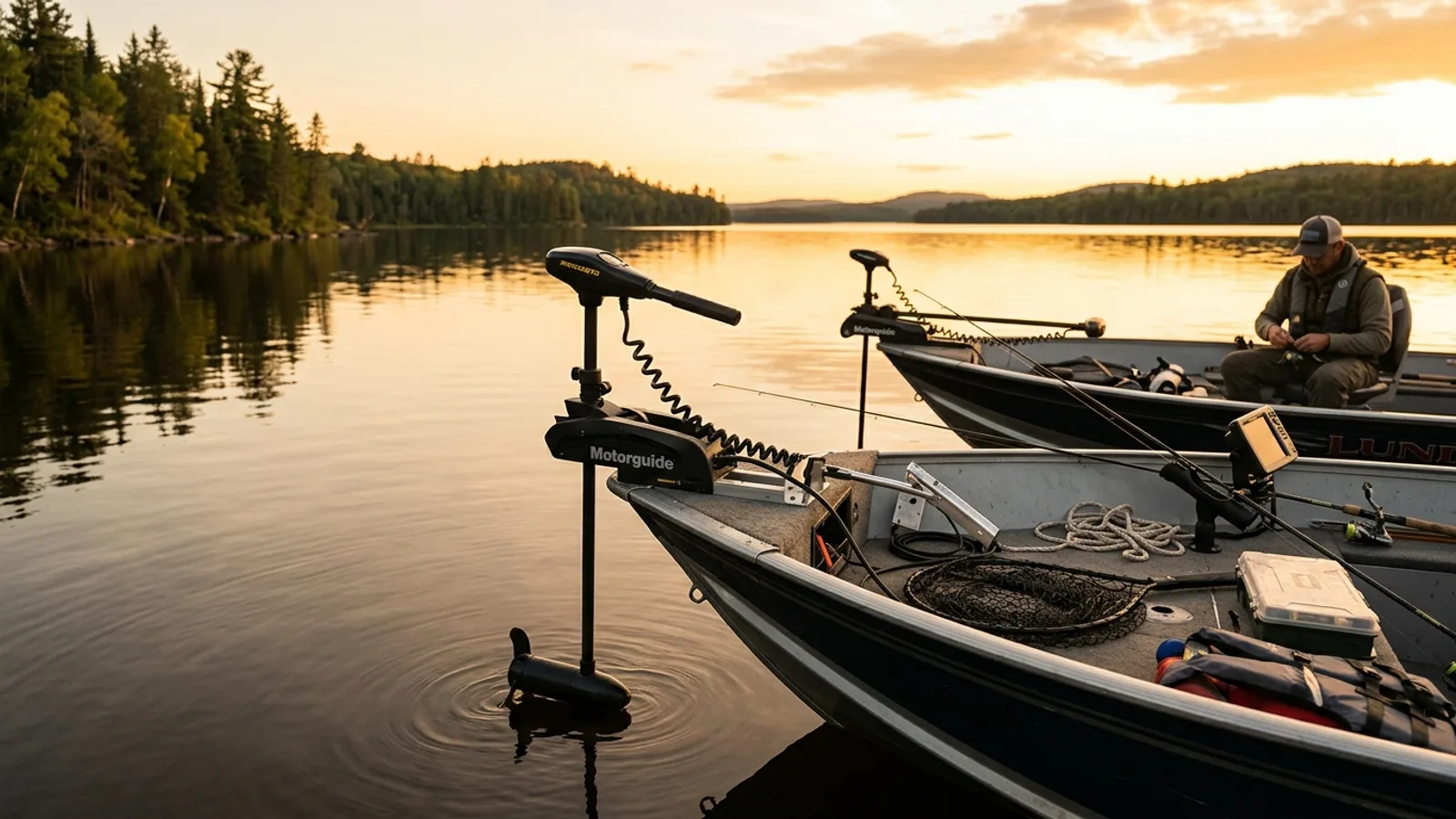
A trolling motor is the quietest fish-catching tool on your boat. It puts you on fish without spooking them, holds you on a spot in wind that would drag an anchor, and on a kayak it turns a two-mile paddle into a five-minute cruise. The market runs from $120 tiller-steer transom motors to $2,000 GPS-anchoring bow mounts, and the right answer depends almost entirely on two things: what you fish from, and how much your loaded boat weighs.
This guide covers all four buying situations: bow-mount with Spot-Lock, budget transom-mount, kayak motors, and 24V motors for bigger water. If you want a quick answer, jump to quick picks. If you're not sure how much thrust you need, the sizing rule takes 30 seconds.
At a Glance
 Minn Kota Terrova 55/IP Freshwater Bow-Mount Trolling...
 Minn Kota Endura C2 30 Freshwater Transom Mounted...
 Newport NK180 Kayak Trolling Motor w/Mounting &...
 Newport Kayak Series 36lb Thrust Transom Mounted...
![Garmin Force Kraken Trolling Motor - 63" - White [010-02574-00]](https://m.media-amazon.com/images/I/2186L37EqiL._SL500_.jpg) Garmin Force Kraken Trolling Motor - 63" - White...
Garmin Force Kraken Trolling Motor - 63" - White...
Product images and titles from Amazon. As an Amazon Associate we earn from qualifying purchases.
Quick Picks by Use Case
| Use case | Best Pick | Why | Price |
|---|---|---|---|
| Best overall | Minn Kota Terrova 55 (i-Pilot) | Spot-Lock, proven reliability, 12V simplicity | $1,400–1,800 |
| Budget pick | Minn Kota Endura C2 30 | Bulletproof, simple, around $120–150 | $120–150 |
| Budget step-up | Minn Kota Endura Max 55 | Variable speed doubles battery run time | $300–400 |
| Best for kayaks | Newport NK180 | Brushless, 14 lbs, huge range | $1,000–1,300 |
| Budget kayak | Newport Kayak Series 36 lb | Short shaft built for kayak transoms | $150–220 |
| Best 24V big water | Minn Kota Terrova 80 | 80 lb thrust, 60" shaft, Spot-Lock | $1,800–2,300 |
| Premium alternative | Garmin Force Kraken | Brushless power, Garmin integration | $2,000–3,000 |
How Much Thrust Do You Need? (The 2-per-100 Rule)
Thrust sizing is where most people go wrong, and it's the first thing to settle before you look at features. The rule is simple: at least 2 lbs of thrust for every 100 lbs of fully loaded boat weight. Fully loaded means the hull, outboard, fuel, batteries, gear, cooler, and every person aboard, not the dry weight on the spec sheet.
- Loaded kayak (400–600 lbs): 30–40 lbs of thrust is plenty.
- Jon boat or small aluminum (900–1,500 lbs): 30–40 lbs works, 45–55 gives headroom.
- Bass boat (2,000–2,800 lbs loaded): 55 lbs minimum, 70–80 preferred.
- Deep-V, pontoon, or multi-species rig (3,000–4,000 lbs): 70–80 lbs on a 24V system.
- Over 4,000 lbs: 100+ lbs on a 36V system.
Treat the rule as a floor, not a target. Wind, current, and a hull with lots of freeboard all eat thrust, and a motor running at 60% throttle is quieter and drains the battery far slower than one pinned at 100% all day. If you fish the Great Lakes or big reservoirs (check the depth contours on our Lake Michigan depth chart to see how fast that water gets serious), size up a class.
Bow-Mount Motors with Spot-Lock (Best for Boats)
If you fish from a boat with a casting deck, a bow-mount motor with GPS anchoring is the single biggest upgrade you can make. Spot-Lock holds the boat on a GPS waypoint automatically, correcting for wind and current, which means you can sit on a brush pile in 15 mph gusts and fish with both hands. Once you use it, anchors feel prehistoric.
Minn Kota Terrova 55 (i-Pilot)
The Terrova is Minn Kota's best-selling bow mount for a reason: it hits the sweet spot of price, thrust, and features for the boats most people actually own. The 55 lb thrust 12V version with i-Pilot gives you Spot-Lock, autopilot heading hold, cruise control, and route recording from a wireless remote, and it runs off a single deep-cycle battery. The stow/deploy lever with lift-assist means no wrestling the motor onto the deck at the ramp.
With 55 lbs of thrust it comfortably handles boats up to roughly 2,800 lbs loaded, which covers most aluminum bass boats, tin deep-Vs, and smaller fiberglass rigs. If your loaded weight is above that, skip ahead to the Terrova 80.
Pros
- Spot-Lock holds position within a few feet even in wind
- Single-battery 12V system keeps cost and weight down
- Lift-assist stow/deploy is easy on your back
- Massive parts and service network
Cons
- Brushed motor is louder than newer brushless designs
- 55 lbs of thrust is undersized for boats over ~2,800 lbs loaded
- Remote is another thing to keep charged
Minn Kota Terrova 80
Same platform, more muscle. The Terrova 80 runs on 24V (two batteries in series), puts out 80 lbs of thrust, and comes in 60-inch shaft lengths that keep the prop buried when a deep-V bow is rising and falling in two-foot chop. This is the right motor for walleye boats, multi-species deep-Vs, pontoons, and anyone fishing big reservoirs or Great Lakes bays where wind is a daily fact of life.
The 24V system is also more efficient per pound of thrust than a 12V motor working at its limit, so you get longer run time on Spot-Lock even though you're pushing a heavier boat. If you troll open water for walleye or salmon in places like Michigan or Minnesota, this class of motor is the standard for a reason.
Pros
- 80 lbs of thrust handles 3,000–4,000 lb loaded boats
- 60" shaft option keeps the prop submerged in chop
- Full i-Pilot feature set including Spot-Lock and autopilot
Cons
- Needs two batteries, more weight and wiring
- $1,800+, and lithium batteries add more on top
Garmin Force Kraken
Garmin's Force Kraken brings a brushless motor to the bow: quieter, more efficient, and noticeably stronger under load than brushed competitors. It runs on 24V or 36V from the same unit, delivers up to 100 lbs of thrust, and its anchor-lock and heading-hold match Minn Kota's feature set. The killer feature is integration: if you already run a Garmin chartplotter or LiveScope, you can control the motor from the screen, lock onto waypoints, and follow depth contours.
The wireless remote works like a video game controller and includes a built-in gesture mode, point where you want to go and the motor follows. If your electronics are Garmin, this is the obvious pick over the Terrova. If they're not, the Minn Kota ecosystem is cheaper and more common. Pair it with one of our best fish finders picks if you're building the system from scratch.
Pros
- Brushless motor is quieter and more efficient
- Runs 24V or 36V from the same motor
- Deep integration with Garmin chartplotters and LiveScope
Cons
- $2,000–3,000 depending on shaft and kit
- Best features require Garmin electronics
- Heavier than the Terrova on the bow
Transom-Mount Motors (Budget & Small Boats)
Transom-mount tiller motors clamp to the back of the boat and steer by hand. No GPS, no remote, no deck install, and no $1,500 price tag. For jon boats, dinghies, canoes, and small aluminum hulls, they're all most people need, and the reliability of the simple designs is legendary.
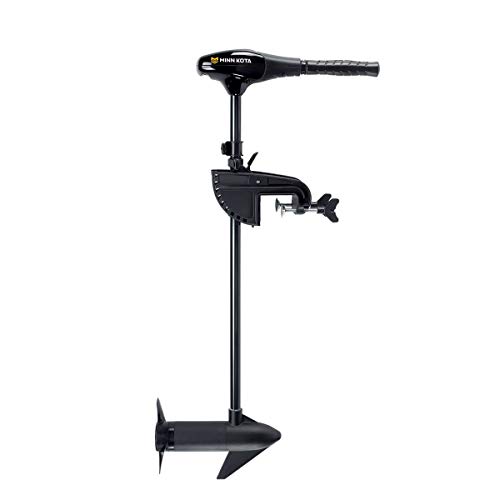
Minn Kota Endura C2 30
The Endura C2 30 is one of the most widely owned trolling motors ever made. Thirty pounds of thrust, a 30-inch composite shaft that's guaranteed for life, a telescoping tiller, five forward speeds and three reverse, and a lever-lock bracket that clamps to nearly any transom. That's the whole story, and that's the point: there is nothing on it to break.
By the 2-per-100 rule, 30 lbs of thrust moves a loaded boat up to about 1,500 lbs, which covers a 12–14 ft jon boat with two anglers and gear on calm water. It's also a fine trolling and backup motor for canoes and small V-hulls. Budget a deep-cycle marine battery alongside it; a car battery will die fast under deep discharge.
Pros
- Around $120–150, the entry point to electric power
- Composite shaft carries a lifetime warranty
- Dead simple, nothing to fail
Cons
- Fixed 5-speed settings waste battery at low speeds
- No battery meter on the base model
- 30 lbs of thrust is calm-water power only
Minn Kota Endura Max 55
The Endura Max adds the one feature worth paying for on a tiller motor: Digital Maximizer variable-speed control. Instead of five fixed speeds that burn power through resistors, the Max delivers exactly the throttle you dial in, which Minn Kota rates as up to five times longer run time on a charge. On an all-day trip with one battery, that's the difference between fishing until dark and paddling home.
At 55 lbs of thrust it will push a loaded 16 ft aluminum boat or a heavy jon boat around all day, and the battery meter on the head tells you how much day you have left. If you're only ever fishing an hour at a time, save the money and get the C2. If you fish full days, the Max pays for itself in batteries you don't kill.
Pros
- Variable speed control dramatically extends run time
- 55 lbs of thrust covers boats to ~2,800 lbs loaded
- Built-in battery meter
Cons
- Roughly triple the price of the C2 30
- Still tiller-only, no GPS or remote features
Kayak Trolling Motors
Kayaks need short shafts (24–36 inches), light weight, and efficient power draw, because every pound of motor and battery comes out of your gear capacity. A motorized kayak covers water like a small boat while launching anywhere you can carry it. If you're still shopping for the hull itself, start with our best fishing kayaks guide and pick a model with a motor mount or reinforced transom.
Newport NK180
The NK180 is purpose-built for kayaks rather than adapted from a boat motor: a brushless direct-drive unit rated at 1.8 hp equivalent, weighing just over 14 lbs, with a mounting and steering bracket kit included. It runs on 24V (lithium recommended) and sips power, Newport rates it to enormous range at low speed because brushless drives waste so little energy. It's also close to silent, which matters when you're gliding onto a flat in three feet of water.
This is the motor for kayak anglers who fish big water, cover miles between spots, or troll all day. Pair it with a 24V lithium battery to keep total system weight under 40 lbs.
Pros
- Brushless drive: quiet, efficient, huge range
- 14 lbs, barely dents your kayak's capacity
- Mounting and steering hardware included
Cons
- $1,000+, plus a 24V lithium battery
- Overkill for pond and small-lake paddlers
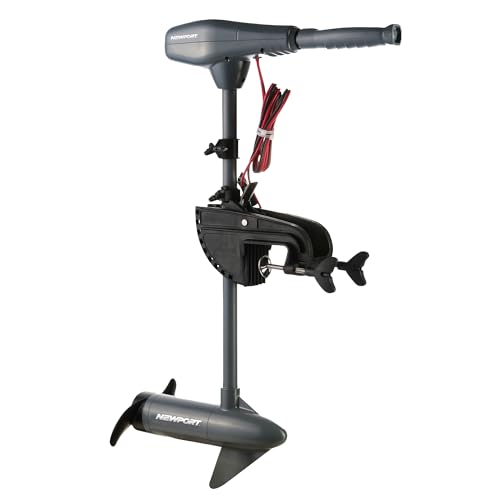
Newport Kayak Series 36 lb
Newport's Kayak Series takes a conventional 12V transom motor and fixes the thing that makes standard motors awkward on kayaks: the shaft. At 24 inches it's sized for a kayak transom instead of a boat, so the head sits at a natural tiller height instead of towering over your shoulder. You get 36 lbs of thrust, five forward and three reverse speeds, and a battery meter.
By the sizing rule, 36 lbs of thrust is more than enough for any loaded fishing kayak, and it will happily push a canoe or float tube setup too. With a mount like a universal kayak motor mount and a group 24 battery, you're motorized for around $350 all-in.
Pros
- 24" shaft actually fits kayak geometry
- Around $150–220, cheapest path to a powered kayak
- 36 lbs of thrust is plenty for any kayak
Cons
- Brushed motor, fixed speeds, shorter run time than the NK180
- Tiller steering means one hand off the rod while running
- Lead-acid battery weight adds up fast on a kayak
How to Choose: The Decision Framework
- Size thrust first. Total up your loaded boat weight and apply the 2-per-100 rule, then round up a class if you fish wind, current, or big water. Nothing else matters if the motor can't hold your boat.
- Match voltage to thrust. Up to 55 lbs = 12V and one battery. 68–80 lbs = 24V and two batteries. 100+ lbs = 36V. Don't forget the batteries in your budget; they can add $150–900 depending on lead-acid vs lithium.
- Decide if GPS anchoring earns its cost. If you fish structure from a boat, Spot-Lock is worth every penny. If you mostly troll in straight lines or fish small water, a $300 tiller motor does the job.
- Get the shaft length right. Mounting point to waterline, plus 20 inches. Too short and the prop ventilates in chop; too long and you're clipping bottom in the shallows.
- Think about your electronics. Garmin screens pair with Force motors, Minn Kota pairs with Humminbird. Buying the motor and fish finder as one ecosystem unlocks features like contour following.
Essential Accessories
- 12V 100Ah lithium battery, half the weight of lead-acid and it holds voltage until it's nearly empty, so the motor stays strong all day.
- Battery box with terminals, protects the battery, adds a circuit breaker point, and keeps terminals off wet decks.
- 60-amp circuit breaker, required by most motor manufacturers and cheap insurance against a fried motor if the prop jams.
- Onboard battery charger, plug in one cord at the ramp instead of hauling batteries to the garage.
- Quick-release bracket, lets you pull a bow mount off in minutes for theft prevention or trailering.
- Spare weedless prop and nut kit, props hit rocks. Carry a spare with the wrench taped to it.
- Tiller extension handle, for transom motors, lets you steer from the middle seat and trim the boat properly.
Frequently Asked Questions
How much thrust do I need for a trolling motor?
Use the 2-per-100 rule: at least 2 lbs of thrust for every 100 lbs of fully loaded boat weight, including motor, fuel, gear, and passengers. A 2,500 lb loaded bass boat needs 50 lbs minimum, so a 55 lb motor is the floor and 70–80 lbs is better in wind or current. Undersizing is the most common trolling motor mistake, and there is no real penalty for extra thrust other than price.
Is Spot-Lock worth the extra money?
For most boat anglers, yes. GPS anchoring holds your boat on a waypoint automatically, correcting for wind and current, and it replaces the anchor entirely. You can sit on a brush pile or a ledge in gusty wind and fish with both hands the whole time. Expect to pay roughly $400–700 more than a comparable non-GPS motor, and expect to consider it the best money you've spent on the boat.
12V vs 24V trolling motor: which do I need?
12V motors top out around 55–62 lbs of thrust and run off one battery, right for boats under roughly 2,800 lbs loaded. 24V motors deliver 68–80+ lbs with better efficiency per amp, the right call for boats over 3,000 lbs, big water, or all-day Spot-Lock use. The extra battery is the real cost of 24V, in both dollars and deck space.
What size battery should I buy?
A 100Ah group 27 or 31 deep-cycle battery per 12V of motor voltage is the standard. Lithium (LiFePO4) costs more up front but weighs about half as much, holds voltage under load, and survives 5–10x more charge cycles. On a kayak, lithium is close to mandatory because of weight.
What shaft length do I need?
Measure from the mounting point to the waterline and add 20 inches so the prop stays about a foot underwater in chop. Bass boat bow mounts usually land at 45–52 inches, deep-V and big-water boats at 54–62 inches, and kayaks or jon boat transoms at 24–36 inches.