Fishing Knots Every Angler Should Know: 8 Essential Knots
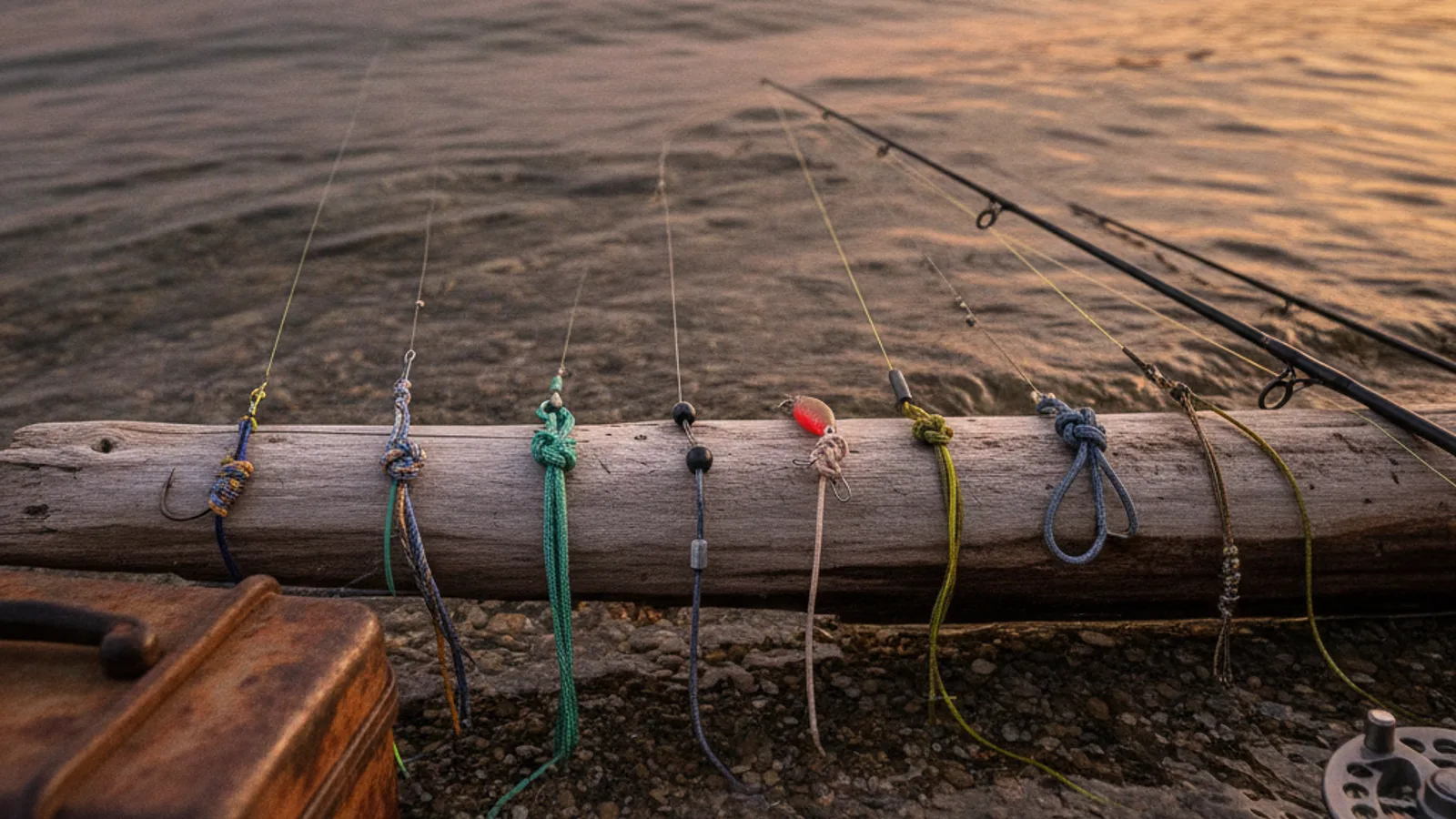
Your fishing knot is the weakest link between you and the fish. Literally. A poorly tied knot can fail at 50% of your line's rated strength, turning a trophy catch into a heartbreaking story. Master these 8 essential knots and you'll handle any fishing situation, from tying on a hook to connecting braid to fluorocarbon leader.
Golden Rule: Always wet your knots with saliva or water before cinching them tight. Dry knots generate friction heat that weakens monofilament and fluorocarbon by up to 30%. Wet, pull slowly, then finish with a firm final pull.
Hook and Lure Knots
1. Improved Clinch Knot
The most popular fishing knot in the world, and the first one every angler learns. Quick, reliable, and works with monofilament and fluorocarbon lines up to about 30 lb test.
How to tie:
- Thread the line through the hook eye, leaving 6 inches of tag end
- Wrap the tag end around the standing line 5-7 times
- Pass the tag end through the small loop near the hook eye
- Pass the tag end through the big loop you just created
- Wet and pull tight against the hook eye. Trim the tag.
When to use: Your everyday knot for attaching hooks, lures, and swivels to monofilament or fluorocarbon. Not recommended for braided line (it slips).
2. Palomar Knot
One of the strongest terminal knots and nearly as easy as the clinch. It works with all line types including braided line, making it incredibly versatile. Many experienced anglers use the Palomar as their primary knot for everything.
How to tie:
- Double 6 inches of line and pass the loop through the hook eye
- Tie a simple overhand knot with the doubled line (don't tighten yet)
- Pass the loop over the entire hook or lure
- Wet and pull both the standing line and tag end to tighten
- Trim the tag end
When to use: Anytime you tie a hook, lure, or swivel. Works with braid, mono, and fluoro. If you only learn two knots, this should be one of them. Essential for saltwater fishing setups.
3. Uni Knot
The Swiss Army knife of fishing knots. The uni knot ties hooks, connects two lines (double uni), spools line onto reels, and creates loop connections. Learn this one knot and you can handle almost any situation on the water.
How to tie (to a hook):
- Thread the line through the hook eye, leaving 8 inches of tag end
- Fold the tag end back to create a loop alongside the standing line
- Wrap the tag end through the loop and around both lines 5-6 times
- Wet and pull the tag end to tighten the coils
- Slide the knot down to the hook eye and pull the standing line tight. Trim.
When to use: Versatile enough for nearly every situation. Use the double uni version to join two lines of similar diameter.
4. Snell Knot
The snell wraps around the hook shank rather than tying through the eye, creating a direct pull that helps circle hooks rotate and set properly. It's the preferred knot for catch and release fishing with circle hooks.
How to tie:
- Thread the line through the hook eye from the point side
- Form a loop alongside the hook shank
- Wrap the tag end around the shank and line 7-8 times, working down toward the bend
- Hold the wraps in place and pull the standing line to tighten
- Ensure the line exits from the point side of the eye. Trim the tag.
When to use: Live bait fishing with circle hooks, especially for saltwater bait fishing. Creates the ideal angle for circle hook performance.
Line-to-Leader Knots
5. FG Knot
The FG knot is the gold standard for connecting braided line to fluorocarbon or monofilament leader. It's slim enough to pass through rod guides without catching, maintains near 100% line strength, and handles any line combination. The trade-off? It takes practice to learn.
How to tie:
- Hold the leader horizontal and tight (between your teeth and hand works)
- Weave the braid over and under the leader in alternating wraps, 15-20 wraps total
- Each wrap should be snug against the previous one
- Finish with 2-3 half hitches on the standing line, then 2-3 on the leader tag
- Trim both tags close. The finished knot should be small and streamlined.
When to use: Primary braid-to-leader connection for surf fishing, inshore fishing, and any application where you need the knot to pass through guides smoothly.
6. Alberto Knot (Modified Albright)
If the FG knot is too finicky for you, the Alberto is an excellent alternative. It's faster to tie, still very strong, and handles braid-to-leader connections reliably. The finished knot is slightly bulkier than the FG but passes through guides well enough for most fishing situations.
How to tie:
- Double over 6 inches of the leader to create a loop
- Thread the braid through the loop
- Wrap the braid around the doubled leader 7 times going away from the loop
- Then wrap back 7 times going toward the loop
- Thread the braid tag back through the loop, wet, and cinch tight. Trim.
When to use: When you need a braid-to-leader connection but don't want to wrestle with an FG knot. Great for pier fishing and general inshore use.
Utility Knots
7. Surgeon's Loop
Creates a strong loop in the end or middle of your line. Essential for building dropper rigs (like pompano rigs), loop-to-loop connections, and anywhere you need a fixed loop.
How to tie:
- Double the line where you want the loop
- Tie an overhand knot with the doubled line
- Pass the loop through the overhand knot a second time (making it a double overhand)
- Wet and pull tight. Trim if it's a terminal loop.
When to use: Building rigs, creating loop connections, anywhere you need a reliable loop. Especially useful for surf fishing rigs.
8. Blood Knot
The classic knot for joining two lines of similar diameter. Creates a clean, symmetrical connection that passes through rod guides. Commonly used in fly fishing for building tapered leaders, but useful for any line-to-line connection.
How to tie:
- Overlap the two line ends by about 6 inches
- Wrap one tag end around the other line 5 times
- Bring the tag back and thread through the gap between the two lines at the center
- Repeat with the other tag end, wrapping 5 times in the opposite direction
- Thread through the center gap from the opposite side. Wet and pull both standing lines to tighten.
When to use: Joining two monofilament or fluorocarbon lines of similar diameter. Not ideal for braid-to-leader (use FG or Alberto instead).
Knot Tips for Success
- Practice at home, not on the water. Tie each knot 20 times before your next trip until it becomes muscle memory.
- Always wet your knots. This bears repeating, dry tightening weakens line significantly.
- Test every knot. Give a firm pull after tying to make sure it's seated properly. Better to fail at the dock than on a fish.
- Trim your tags. Long tag ends catch weeds, spook fish, and look sloppy. Trim to 1/8 inch.
- Retie regularly. Inspect and retie your knots every hour or after catching a fish. Nick or abrasion near the knot can cause failure.
- Use the right knot for your line type. Clinch and blood knots work for mono/fluoro but slip on braid. Palomar and uni knots work on everything.
Which Knots to Learn First
If you're just starting out, learn these three knots and you'll handle 90% of fishing situations:
- Palomar knot, for tying hooks and lures (any line type)
- Double uni knot, for joining two lines (braid to leader)
- Surgeon's loop, for building rigs and loop connections
As you advance, add the FG knot for a superior braid-to-leader connection and the snell knot for circle hook fishing.
Ready to Fish? Check Conditions First
Knots tied? Check tides, weather, and fishing scores for your spot, free for 3,900+ locations.
Check Fishing Conditions →Frequently Asked Questions
What is the strongest fishing knot?
The FG knot (95-100% strength) for line-to-leader. The Palomar knot (95%+) for hook connections. Both are near-perfect when tied correctly.
What is the easiest fishing knot to tie?
The improved clinch knot, learn it in 30 seconds. The Palomar is nearly as easy and stronger. Master both first.
Should I wet my fishing knots before tightening?
Yes, always. Dry tightening creates friction heat that can weaken mono and fluoro by up to 30%.
How do I connect braided line to fluorocarbon leader?
The FG knot is the gold standard. The Alberto knot and double uni are easier alternatives that work well for most fishing.
As an Amazon Associate Fishn Buddy earns from qualifying purchases. Links below help support our work at no cost to you.
Knot-Tying Gear We Recommend
- Fluorocarbon leader line (20 lb), The FG and double-uni knots connecting braid to fluoro are the most-used connections in modern fishing. Seaguar Red Label and Berkley Vanish are the go-to values; Seaguar InvizX is the step-up option for clear water.
- Braided fishing line (10–30 lb), Braid’s zero-stretch makes bite detection far better than mono. PowerPro Spectra and Sufix 832 are the most trusted freshwater braids; pair with a 10-ft fluoro leader using the FG knot.
- Line scissors / braid cutters, Braid cannot be bitten through reliably and dulls cheap scissors fast. A dedicated braid cutter (Rapala or KastKing) makes clean cuts and lasts years. Keep one in every tackle box.
- Barrel swivel kit (sizes 8–14), The uni-to-uni knot is the standard connection for attaching swivels. A mixed-size kit covers everything from finesse panfish rigs to heavier bass and walleye setups.
- Hook assortment kit (sizes 1–8), The Palomar and improved clinch knots are only as good as the hooks you tie them to. A mixed-hook assortment with wire hooks for panfish and offset worm hooks for bass covers 80% of freshwater situations.
- Line conditioner / knot lubricant, Wetting a knot before cinching down is critical for fluorocarbon (dry friction weakens it). A dedicated line conditioner reduces memory on mono and fluoro, making casting smoother and knots tighter.
See our full gear guide: Best Fishing Rod & Reel Combos 2026 and Best Polarized Sunglasses for Fishing 2026.
FISH SMARTER ⚓
FIND YOUR SPOT →